

Free VSTs, modules for VCV Rack 2 and effects for the Korg NTS-3 kaoss pad made possible with AI-assisted development. Exploring synthesis, effects, and modulation rooted in physical modeling, astronomical mathematics, and classic hardware architecture.
- Jupiter Modulation Station v1.0 Initial release — Win VST3, Mac VST3, Mac Audio Unit.
- VCV Rack Plugins v2.7.9 Deeper schematic-level auditing and revision of several classic hardware emulation modules.
- VCV Rack Plugins v2.7.8 Bug fixes and improvements.
- VCV Rack Plugins v2.7.7 Added EclipseGate, PhaseMod-8, JovianCore-8, and Blueshift-129. General bug fixes and improvements.
- VCV Rack Plugins v2.7.5 Added Macrocosm-1, JP-6 Filter, Choral-60, Ensemble-4, ChorusEcho-301, ComSys-80 Vibes
- VCV Rack Plugins v2.5.9 Added ElectroRhythm-1 and ElectroMachine-1
VST Plugins VST / AU
Standalone VST3 and Audio Unit plugins for your DAW.
Jupiter Modulation Station
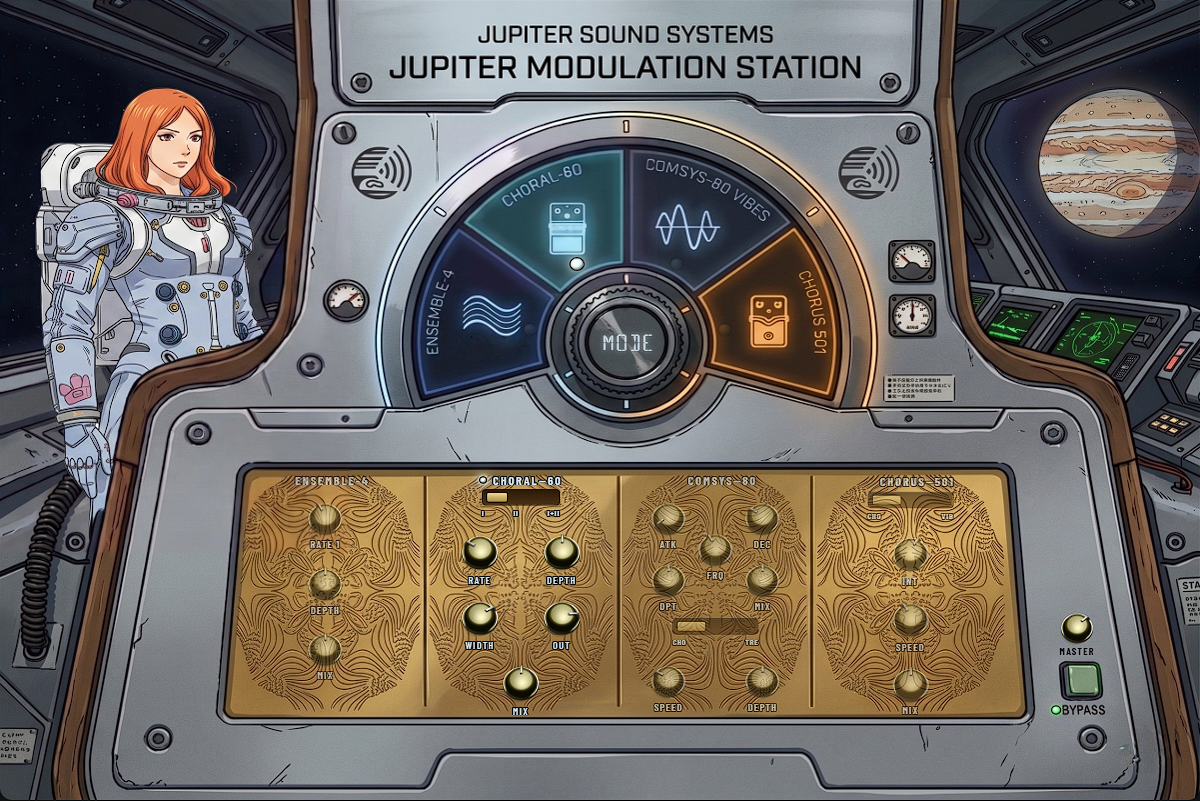
ModulationYou and Anna-1 are running experiments in modulating the electrical conductivity of Jupiter from the comfort of your spaceship — with four modulation algorithms inspired by classic hardware: Ensemble-4, Choral-60, ComSys-80 Vibes, and Chorus-501.
Inspired by Darkware 00's SynthEdit VSTs and utilizing frequencies from the research paper Electrical conductivity of Jupiter's shallow interior and the formation of a resonant planetary-ionospheric cavity.
Made possible thanks to Claude Opus, Gemini, Stable Diffusion, NanoBanana, KnobMan3D and Pluginmaker.ai
VCV Rack 2 ModulesVCV Rack 2
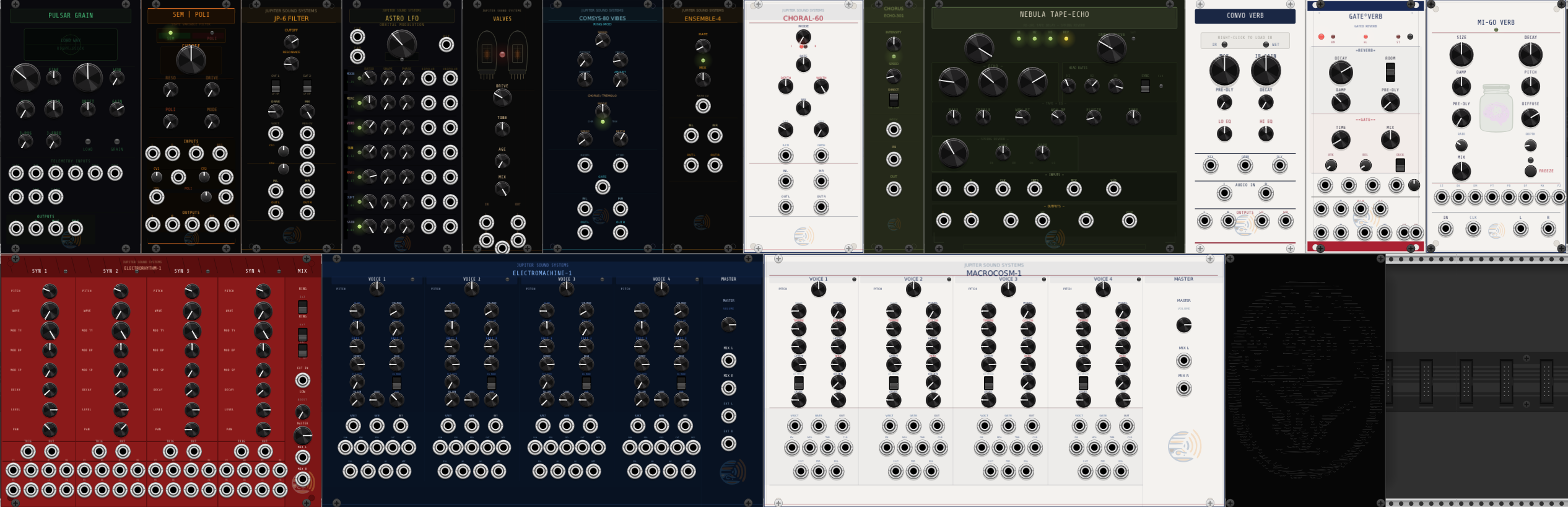
Free modules for VCV Rack 2 — oscillators, filters, effects, modulation, and more.
Windows Installation
- Download
JupiterSoundSystems-2.7.9-win-x64.vcvplugin - Open your plugins folder:
%LOCALAPPDATA%\Rack2\plugins
Or in VCV Rack 2: Library → "Open plugins folder" - Easy way: double-click the
.vcvpluginfile, or drag it onto the VCV Rack window — Rack installs automatically - Manual: copy the
JupiterSoundSystemsfile into the plugins directory - Restart VCV Rack 2. Search "Jupiter" or any module name in the module browser
Linux Installation
- Download
JupiterSoundSystems-2.7.9-lin-x64.vcvplugin - Plugins directory:
~/.local/share/Rack2/plugins
May be~/.Rack2/pluginson some distros - Easy way: drag the
.vcvpluginonto the VCV Rack window, or copy it:cp JupiterSoundSystems-2.7.9-lin-x64.vcvplugin ~/.local/share/Rack2/plugins/ - From tarball:
tar xzf JupiterSoundSystems-lin-x64.tar.gz -C ~/.local/share/Rack2/plugins/ - Restart VCV Rack 2. Search "Jupiter" or any module name in the browser
Pulsar Grain
Granular-Pulsar OscGranular-pulsar synthesis engine. Single-voice, stereo output. Loads a .wav file as the pulsaret source. Pulsar frequency controls grain firing rate; duty cycle controls sound-to-silence ratio — narrow cycles produce metallic slivers, wide ones let the sample breathe. Grain pitch is fully independent of emission rate.
- Scan position, start/end windowing, grain envelope
- 2× internal oversampling
- 16HP
Phase Mod-8
PM OscillatorNord G2-style phase modulation operator. A carrier sine running at pitch with a modulation input that phase-modulates the carrier before evaluation. Single-operator design intended to be stacked externally — chain several together to build arbitrary FM algorithms without the fixed topology of a traditional DX-style voice.
- V/Oct, PM input (audio-rate), PM index CV, frequency ratio knob
- Polyphonic
- 6HP
Jovian Core-8
Dual VCODual VCO modeled on the Roland Jupiter-8. Discrete analog oscillator physics: FET-reset integrator ramp with ~3% exponential discharge transient at reset (the characteristic Jupiter rounding at the saw top), triangle-derived sine via Padé soft-clipping shaper with 1% second-harmonic injection, S-curved PWM response, and signal-dependent cross-mod VCA bleed. Two oscillators per voice with independent waveforms, PW, pitch, fine tune, and level.
- Cross-modulation, oscillator sync, and ring modulation routing
- V/Oct, PW CV, PWM CV, sync, and X-mod CV inputs per oscillator
- 20HP
Astro-LFO
Astronomical LFOSeven-channel astronomical LFO. Each channel corresponds to a celestial body — Moon, Mercury, Venus, Sun, Mars, Jupiter, Saturn — running at a frequency derived from its real orbital period. A base warp factor compresses the timescales into musically useful LFO rates, and per-planet ratio knobs (1/16× to 16×) let you shift individual orbits into different subdivisions while maintaining the underlying proportional relationships.
- BPM sync locks the system to the DAW transport
- Seven correlated-but-distinct CV outputs
- Relative speeds reflect actual solar system geometry
- 12HP
SEM|POLI
State Variable FilterDual-character filter using TPT/Cytomic architecture. The Character knob crossfades between SEM mode (Oberheim — gentle, musical) and POLI mode (Polivoks — explosive top-end with slew-limited integrators and rail-interaction drive).
- LP, BP, HP, and notch outputs simultaneously
- 2× internal oversampling
- Dual cutoff CV with attenuverters
- 10HP
JP-6 Filter
State Variable FilterDual state-variable filter modeled on the Roland Jupiter-6's IR3109 OTA design. Two SVF stages in series, each independently switchable between low-pass and high-pass. OTA saturation modeled inside the SVF integrators — distortion character changes with resonance and cutoff position, just like the real IC. Resonance compensation keeps volume consistent as resonance climbs.
- Series dual-stage LP/HP switching per stage
- V/Oct input for keyboard tracking
- OTA integrator-level saturation — not a pre-filter waveshaper
Eclipse Gate
Polymetric SequencerEight-channel polymetric gate sequencer. Each channel has its own pattern length (1–64 steps), clock division, direction (forward, reverse, ping-pong, random), and editable gate states across four pages of 16 steps. Channels run independently against a shared master clock, so patterns of different lengths phase against each other over time — classic polymeter. Visual playhead indicators per channel with hasPlayed latch.
- Eight individual gate outputs plus summed mix output
- Per-channel probability, swing, and mute
- 32HP
ElectroRhythm-1
Percussion SynthFour-voice virtual analog percussion synthesizer inspired by the Korg Electribe ER-1. Each voice: oscillator through pitch modulator (six types including audio-rate FM and S&H) into an exponential decay envelope. Ring mod between voice pairs.
- Sine, triangle, saw, square oscillators
- Per-voice trigger, accent, and pitch CV
- 16HP
ElectroMachine-1
4-Voice SynthFour-voice MMT-style synthesizer inspired by the Korg Electribe EMX-1. Each voice has independent OSC1 and OSC2 routed through one of eleven synthesis algorithms: Waveform, Dual Osc, Unison (6-voice), Osc Sync, Ring Mod, Cross Mod, VPM, Waveshape, Comb Filter, Additive, and Noise. OSC EDIT 1/2 knobs control algorithm-specific parameters.
- Multi-mode TPT SVF filter per voice (LPF, HPF, BPF, BPF+)
- 11 CV inputs per voice — V/Oct, Gate, Synth Mode, Edit 1/2, Cutoff, Resonance, and more
- Master volume with stereo mix output
- 44HP
Macrocosm-1
4-Voice Macro SynthFour-voice macro synthesizer combining the EMX-1 voice architecture with the Mutable Instruments Braids macro-oscillator engine (MIT, Émilie Gillet). Braids models spanning classic analog waveforms, FM, waveshaping, physical modeling, wavetable scanning, formant, granular clouds, and particle noise. TIMBRE and COLOR shape each model's character.
- Dual Korg MS-20 OTA filter — LM13600 variant with TPT integrators and tanh resonance saturation
- HP and LP in series with independent cutoffs and shared PEAK control
- 9 CV inputs per voice — audio-rate FM, exponential decay envelope, glide, level, pan
- 46HP
Nebula Tape-Echo
Tape DelayThree-head tape delay with spring reverb, modeled on the Roland RE-201. Three delay lines at fixed ratios (1.0×, 1.85×, 2.72×) matching the original's tape head spacing. Twelve mode combinations. Magnetic hysteresis tape saturation in the feedback path — each echo pass degrades progressively with history-dependent compression, 80Hz head bump resonance, and bias-dependent HF rolloff. Hermite cubic interpolation on delay reads.
- Bass and treble shelving EQ on the echo path
- 48-allpass spring reverb with true spring sag
- Tap tempo and clock sync
- 16HP
Blue Shift 129
Pitch TransposerMXR Model 129 Pitch Transposer faithfully modeled from Tony Gambacurta's original design notes. A 2048-sample circular buffer at 40kHz internal rate (decimated from host sample rate) written through an Am6072 µ-law companding DAC (µ=40) and read back by two independent 555-style pointers chasing the write head at the transposition ratio. A correlator tracks polarity between the two streams and inverts one if they go out of phase, minimizing splice artifacts. The result is the liquid, warbling pitch shift character of the original unit — not the glassy perfection of digital pitch shifters.
- Four pitch presets (P1–P4, each −12 to +12 semitones), mix, regeneration
- Sweep rate/depth LFO modulation and grit (Am6072 quantization degradation)
- 4-pole Butterworth input LP at 12kHz, 4-pole output LP at 7kHz, tanh output saturation
- 12HP
Valves
Tube SaturationDual 12AX7 vacuum tube saturation physically modeled using Norman Koren's triode plate current equation with published 12AX7 parameters. Two cascaded common-cathode gain stages per channel with coupling capacitor and cathode bypass filtering.
- 4× internal oversampling
- Asymmetric clipping — soft compression positive, hard cutoff negative
- 8HP
Choral-60
BBD ChorusJuno-60 BBD chorus. Single MN3009 (256-stage) bucket-brigade delay model with dual delay lines for stereo output via 180° phase-inverted LFO. Three modes matching the real Juno-60: Mode I (triangle LFO, 0.2–1.5Hz, 1.5–5.1ms sweep), Mode II (triangle LFO, 0.3–2.5Hz, 1.5–3.5ms sweep), Mode I+II (sine LFO, 3–15Hz vibrato, 2.0±0.4ms shallow sweep). Delay ranges from the Juno-6 service manual. Hermite interpolation.
- Three authentic Juno-60 chorus modes
- Stereo out via 180° phase-inverted dual delay lines
Ensemble-4
BBD EnsembleRoland Jupiter-4 ensemble effect. Dual MN3004 (512-stage) bucket-brigade delays with NE571 compander noise reduction. Signal is compressed 2:1 before the BBD and expanded 1:2 after — the key difference from the Juno chorus, giving the JP-4 its characteristically clean, refined quality. MN3004 bandwidth limited to 7kHz, contributing to its warmer, rounder character.
- NE571 compander model for dramatically improved S/N ratio
- Triangle LFO 0.2–3Hz, stereo via 180° phase-inverted second BBD
- Rate CV, Mix knob
- 8HP
ChorusEcho-301
BBD Chorus / VibratoRoland RE-301 BBD chorus/vibrato. Single MN3009 (256-stage) mono delay line. Intensity knob controls LFO depth from subtle shimmer to deep wobble. Speed knob adjusts LFO rate (0.2–4Hz). Direct switch toggles between chorus mode (dry + wet) and vibrato mode (wet only — pure pitch modulation with no dry reference). The RE-301's vibrato mode is its secret weapon.
- Chorus and vibrato modes via Direct switch
- Intensity and Speed knobs with CV
ComSys-80 Vibes
Ring Mod + BBDYamaha CS-80 ring modulator and BBD chorus/tremolo. Ring mod section models the uA796HC four-quadrant multiplier with an IG00150-derived sine carrier oscillator. An AD envelope sweeps carrier speed upward on each gate. BBD section uses a dual MN3005 (4096-stage) model — the deepest delay line in the collection — for the CS-80's characteristic lush, slow modulation.
- uA796HC four-quadrant ring modulator with AD envelope on carrier
- Three BBD modes: Off, Chorus (stereo detuning), Tremolo (amplitude modulation)
GateVerb
Gated ReverbThe reverb tail is shaped by a noise gate with adjustable threshold and hold time, producing the punchy, truncated ambience of 1980s drum production. Feed it a snare and the room blooms then cuts dead.
- Gate threshold, hold, and release controls
- Reverb size, damping, pre-delay, and mix
- 12HP
ConvoVerb
Convolution ReverbLoads impulse response files and convolves the input signal in real time using partitioned FFT overlap-add. Designed for realistic acoustic spaces — concert halls, plates, springs, or any captured environment.
- Stereo in / stereo out
- Pre-delay, size scaling, damping, dry/wet
- 12HP
Mi-Go Verb
Plate ReverbDattorro plate reverb with a pitch-shifting feedback loop, inspired by Mutable Instruments Clouds. Four allpass diffusers feed a cross-coupled tank. Nine decorrelated LFOs modulate the delay taps. Pitch knob shifts each recirculation ±1 octave for classic shimmer. Brain in a jar art!
- Pre-delay with clock sync
- Freeze input holds the reverb tail indefinitely
- 12HP
Harpocrates
Blank PanelNTS-3 Kaoss Pad Korg logue SDK
Free effect units for the Korg NTS-3 kaoss pad kit. Built for ARM Cortex-M7 at 48kHz. All parameters mappable to any NTS-3 control.
Pulsar Grain Port
Granular SynthesisLive audio pulsar synthesis. Captures incoming audio into a 200ms circular buffer (9600 samples, 16-bit = 19.2KB) and reads it back through the pulsar emission engine. Not a file-based sampler — it grabs whatever audio is flowing through the NTS-3 in real time and regrains it. Hermite interpolation on the buffer reads, four window shapes. ~20KB RAM.
- XY pad: X = pulsar frequency, Y = duty cycle
Nebula Tape-Echo Port
Tape DelayVCV Nebula Tape-Echo ported to the NTS-3 with a 12-bit packed tape buffer — two samples per three bytes, 150,000 samples giving 3.1 seconds at 48kHz. The 12-bit quantization (72dB dynamic range) is actually cleaner than the original RE-201's ~50dB tape path (~8.3 effective bits).
- XY pad: X = delay time, Y = feedback
Tape Eater
DegradationOriginal NTS-3 effect. Six degradation stages in series modeling the full lifecycle of audio on deteriorating magnetic media: saturation, bit crushing (16-bit to 1-bit), sample rate reduction (48kHz to 2kHz), wow/flutter, dropout simulation, and flutter echo.
- XY pad: X = overall degradation amount, Y = flutter echo mix
SEM|POLI Port
FilterThe VCV SEM|POLI filter ported to the NTS-3. Full TPT/Cytomic state variable topology with hardware-modeled SEM and Polivoks character modes. All four output types available simultaneously at the module level, routed to mono sum on the NTS-3 output.
- XY pad: X = cutoff, Y = character (SEM→POLI)
Valves Port
Tube SaturationThe VCV Valves dual 12AX7 model ported to NTS-3. Full physical model retained at 48kHz with 4× oversampling via the Cortex-M7 FPU. Gain staging, coupling behavior, and asymmetric clipping are identical to the VCV version.
- XY pad: X = drive, Y = output level
Mi-Go Verb Port
Plate ReverbThe VCV Mi-Go Verb ported to the NTS-3 with one deliberate change: internal delay lines use 12-bit quantization matching pre-v2.0 Parasites Oliverb firmware character. Each recirculation through the feedback loop requantizes the signal — quiet tails dissolve into gritty, textured noise.
- XY pad: X = mix, Y = pitch shift amount
Future Development Aspirations
- In Development NTS-3 effects — effects currently being developed
- Possible 4MS Meta Module ports of existing VCV modules
Donate Support the Work
All modules are free. If you find them useful, crypto donations are appreciated.
Monero XMR
ADDRESS_PLACEHOLDER_XMR
Bitcoin BTC
ADDRESS_PLACEHOLDER_BTC
Ethereum ETH
ADDRESS_PLACEHOLDER_ETH